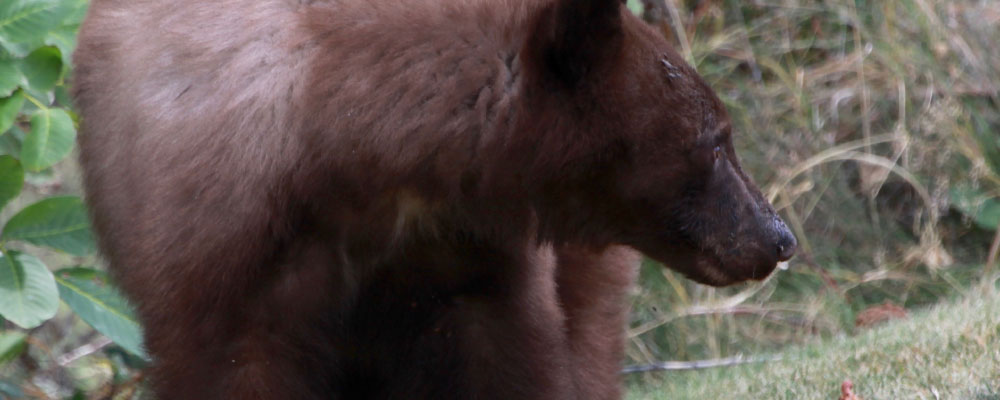
skəm̓ xist

“Our afternoon visitor (Bear)” by Ross Robinson licensed under All Rights Reserved
The syilx People are proud and strong of spirit. They have kept their culture alive in spite of years of government efforts to suppress, eliminate, and destroy their language and their culture, the land, waters, plants and animals for which they have been caring for 11,000 years (Sam, 2013).
skəm̓ xist is one of the Four Food Chiefs. They carry and embody traditional wisdom and thousands year old teachings. In any given collective of human people, there are always those who can be identified as being like skəm̓ xist. It is the practice of the syilx for human people to have roles in community. A diversity of roles means a strong community.
Chief skəm̓ xist represents leadership and tradition. Their role is to keep the people together as the people work together to make decisions for the community (Armstrong, 2019). All perspectives are brought to the table, and skəm̓ xist is there to ensure each one is heard, respected and honoured.
captikwt
The syilx captikwt contain wisdom for collective living, sustainability, and life for future generations. The creation story of How Food Was Given provides the context for many of their understandings that place human people within the web of life (not at the centre of it all). Understanding How Food Was given is fundamental to understanding local knowledge in the Okanagan.
How Food Was Given: An Okanagan Legend
In this re-telling of the Four Food Chiefs, with Sarah Alexis and illustrator Barb Marchand, it is possible to explore the meaning of the gifts from the animal people among the life forces (tmixʷ) of Earth. The diverse perspectives seen and heard in the story are vital to understanding Syilx ways of Knowing and Being.
This version of How Food Was Given has potential for use for adult and child learning alike:
Sarah Alexis is passionate about researching within the field of Aboriginal issues. Constantly working towards understanding more of her Indigenous history, Sarah is learning nsyilxcən and is an increasingly active member of her community and nation. Her interests include Indigenous history, Indigenous forms of health and medicine, Traditional Ecological Knowledge, Indigenous language, and relationships.
Barb Marchand, the illustrator for this video production, is a published author, editor and illustrator of books for children and young adults. Her published credits for her work include: Kou-Skelowh/We are the People: A Trilogy of Okanagan Legends New Bilingual Edition; We are the People: A Trilogy of Okanagan Legends, Kou-Skelowh/We Are the People: How Food Was Given, How Names Were Given & How Tu (Trilogy of Okanagan Legends); Neekna and Chemai.